Quick facts
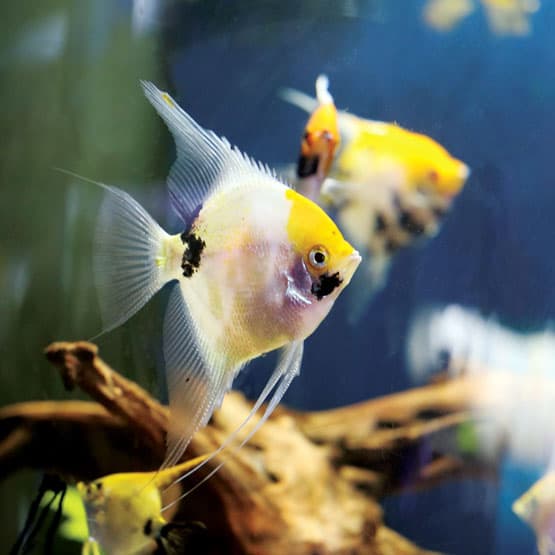
- Covers: common community fish like tetras, livebearers, rasboras, corydoras and angelfish
- Lifespan: varies by species; many live 3–10 years
- Difficulty: beginner, if you're patient at the start
Enclosure
Bigger tanks are easier because the water stays stable longer. A 20-gallon or larger tank is a great first tank.
Before you add fish, the tank has to cycle. Good bacteria need to grow in the filter. This often takes 4–6 weeks. Ask us how to do it.
- A filter sized for your tank
- A heater for tropical fish
- A lid (many fish jump)
Temperature
Most tropical community fish do well around 74–80°F. Use an adjustable heater and a thermometer.
Lighting & UVB
Run the light about 8–10 hours a day. Too much light grows algae. Fish don't need UVB.
Humidity
Not a concern for fish.
Substrate
Gravel or sand both work. Vacuum it during water changes to remove waste.
Diet & feeding
Feed once or twice a day. Only give what they finish in about 2 minutes.
Use a quality flake or pellet. Frozen foods make a good treat. Overfeeding is the #1 way new tanks go bad.
Water
Treat all tap water with a water conditioner before it goes in the tank.
Change about 10–25% of the water every week.
Test your water. Ammonia and nitrite should be zero. Keep nitrate low.
Handling
Fish shouldn't be handled. Use a net to move them.
Bring new fish home quickly. Float the bag to match the temperature before letting them out.
Add only a few fish at a time. Check adult size and who gets along before you buy. Schooling fish like groups of 6 or more.
Common problems & the vet
Most fish problems start with the water. Test it first, then ask us.
- White spots like salt grains: ich
- Ragged, frayed fins: fin rot, often from poor water
- Cloudy water: usually overfeeding or a new tank
- Gasping at the surface: check ammonia and the filter
Questions about your setup? Stop by and ask us.